

Dr. Tabitha A. Amollo is a researcher and lecturer at Egerton University in Njoro in Kenya. She holds a Ph.D. in physics from the University of KwaZulu-Natal, South Africa. Her research interests focus on developing cutting-edge nanomaterials for energy conversion devices including graphene nanomaterials. She published a number of articles in reputable journals. At Egerton University, she is the head of a young team to explore dye-sensitive solar cells, she is a chairperson of the Physics Department, and she coordinates the undergraduate program and gives lectures to undergraduates and postgraduate physics students.
Here in Germany, there are not many women in physics. How is it in Kenya?
That’s similar, only few girls choose physics. In my case, in high school, I had a good physics teacher. I was the best student and he gave me a science book as an award. And this really encouraged me to take physics in the following grade.
What are you working on in your lab?
I am totally fascinated by new organic materials, such as dye sensitive materials for solar cells of the next generations. We are developing such new materials, combining them with graphene and nanostructures, and examining their photovoltaic performance.
What is your connection to BESSY II?
Last November, Dr. Antje Vollmer gave a great talk at my university, Egerton, and we all got really excited about the options at BESSY II. We are really looking forward to start experiments. I will come for the user meeting and beamtime in June 2023 and I will bring some of my students along. It will be a very busy week, we plan to measure our samples to inquire their quantum efficiencies, but also to examine them under the Transmission Electron Microscope, Scanning Electron Microscope and with Atomic Force Microscopy. And I hope to get into contact with the PV-experts at HZB, they have great expertise in perovskite materials, another very fascinating class of materials.
Do you have a vision for the future?
I want to contribute to society with my research in solar energy. We just had a black out here in the lab, we often do, it is a problem. So I am really working to improve the energy system. Solar energy has great potential to provide cheap electricity, and it is fossil free, so it will not contribute to global heating.
How did you start your own lab? What were the first steps?
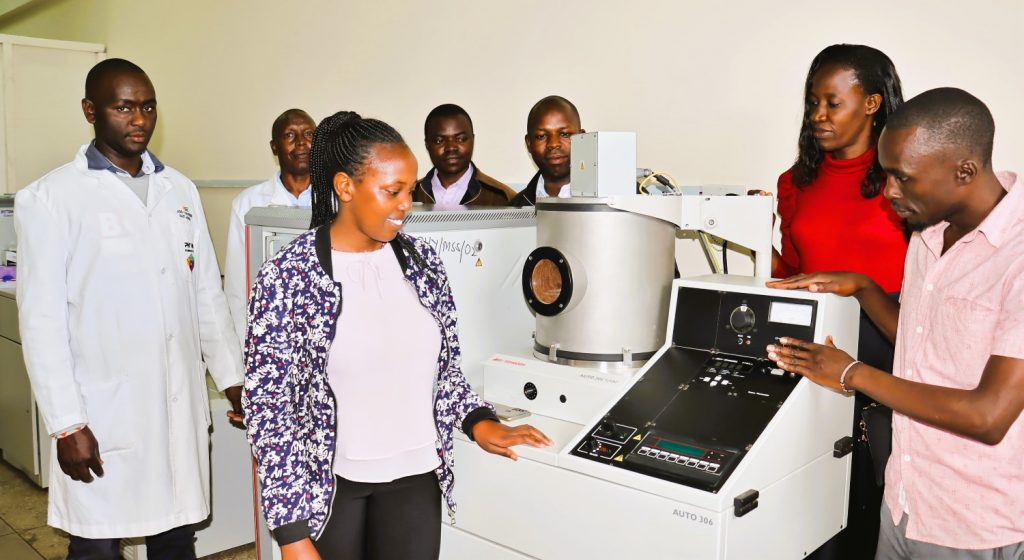
Well, a research lab requires equipment, and for phyisics experiments, these are expensive. I won two research grants, in 2020 and 2022, which financed the equipment acquisition. The focus of my research lab is the development of innovative solar energy conversion materials and technologies.
What is your advice to young students?
I would advise them to keep up their passion, their curiosity. There always are obstacles, and passion gives you the energy to surmount them.
This interview was conducted by Antonia Rötger.
Dr. Tabitha Amollo on the website of Egerton.
This blogpost is part of a series on our cooperation with scientists from Kenya. You can find further articles here.