
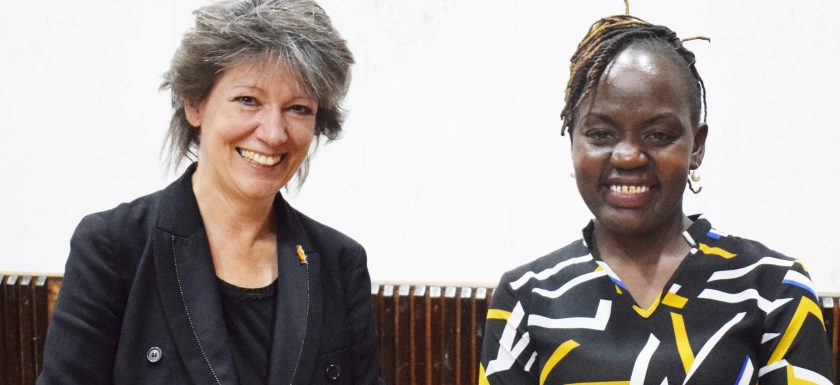
The 2023 User Meeting BESSY@HZB end of June welcomes Kenya as country of honour. Dr Lucy Ombaka from Technical University of Kenya in Nairobi tells us how she got to know about BESSY II light source and how she motivates women in science.
Early May 2023 when we talk, Lucy Ombaka is just back from Berlin, where she spent a few days with the Humboldt Foundation. In 2018 she was awarded a postdoctoral fellowship there. Lecturer in Inorganic Chemistry at the Technical University of Kenya (TUK), Lucy holds a PhD in nanotechnology and catalysis. “I met Antje Vollmer1 from BESSY II during an online Humboldt-Symposium. The topic of our session was Sustainable energy systems. Having all those people together, coming from a lot of countries and exchanging ideas about renewable energy, this was extremely inspiring.”
This Humboldt Symposium was the beginning of an intense and enriching exchange between Dr Lucy Ombaka in Nairobi and Dr Antje Vollmer in Adlershof, both passionate about applied science and solutions for a more sustainable future.
Women in Science
In her research lab in Nairobi, Lucy Ombaka and her group look at green hydrogen and the possibilities for an energy transition in Kenia. “We developed a think tank on green hydrogen with my students Nancy and Daisy and have trainings with GIZ (2) our partner” she underlines. And then she adds smiling, “I love my job! I can contribute academically and in the application of research, it’s awesome to be able to act on both sides.”
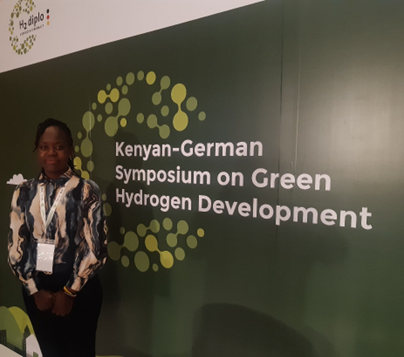
Being in a mostly female team, Lucy confirms that this was intentional: “The best way to inspire and stimulate other women to join is to form a research group with other women. For me this is extremely important: supporting, fostering, and always encouraging women to consider science as a career path”. So, when she brought up her group, she declined a few male chemists until she had several female scientists applying. Lucy wanted first to fill up the positions with ladies, “we need more women, especially in Inorganic Chemistry” she says.
Fascination for BESSY II light source
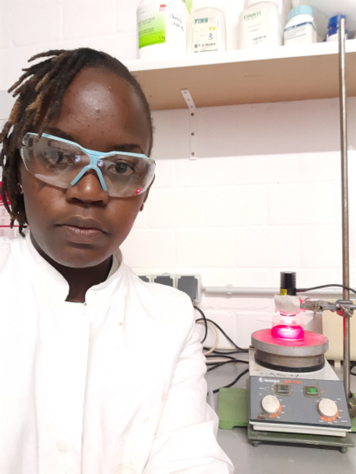
In the past months, Lucy had the chance to visit BESSY II light source. “However, there is so much more to explore and discover,” she says fascinated. “Foremost, I am very eager to learn more about what the instrument can do and I would like to work a few hours on it.” With 16 other scientists Lucy will take part in a two-day twinning programme before the User Meeting and be able to get a close look at how a beamline works, what kind of research she may be able to conduct there. Teams at Helmholtz-Zentrum Berlin have set up several twinning groups to welcome small groups of Kenyan scientists so that they can address their questions to experts in their field.
© private
Lucy Ombaka has been preparing for this special visit since a long time and is very excited: “I cannot wait to talk to the beamline scientists about the work at BESSY II. I have read a lot. Now I want to see on-site what is all possible and we hope to bring some samples along that to measure them at BESSY II.”
End of last year Antje Vollmer came to visit the Technical University of Kenya in Nairobi and gave the scientists some advice to apply for beamtime: “This is definitely something I would like to try, getting beamtime at BESSY II in the future would be amazing! I am very enthusiastic to work hand in hand with other scientists, challenge approaches and open new perspectives together.”
Sources
1Antje Vollmer is facility speaker of BESSY II light source. Read a piece about her in our “Kenya-Series” here.
2GIZ – Deutsche Gesellschaft für Internationale Zusammenarbeit. The GIZ is a service provider in the field of international cooperation for sustainable development and international education work. https://www.giz.de/en/html/index.html
This article is part of a series on our user meeting and our collaboration with our country of honour Kenya. For further articles, see here.